Copyright

All content is provided for your reading enjoyment. Please do not copy/use anything from this site for publication, contests, or personal gain. I am delighted to share my pages with you; if you use something, please give me credit and refer to my blog. Thanks. Dianne

Wednesday, August 21, 2013

Story Coach #2: California Guy

Story Coach Lesson 2: When the News Came

California Guy


The news of Luke’s death came on Monday afternoon,  August 12.   I had just returned home from a week with the Grandchildren and although I don’t usually check the phone for messages, for some reason that day, I did. Ben, another cousin, had called that morning and left the message. 

Ben‘s mother, Daddy’s sister, is elderly and with his, “Dianne, this is Ben,,” I immediately thought the worst. His next words, however, brought relief, “Nothing’s wrong in our family.”  Then he continued, to give me the shocking news. Luke was only 57, five years younger than Ben, 11 years younger than me.  He died of arteriosclerosis.

To our knowledge, he had experienced no health problems of any kind; he was always camping or hiking in the mountains out west or traveling to far away places on some adventure.  Ben and I chatted briefly and he promised to call when he knew any more details. As I hung up, my thoughts immediately went to his children, a boy and a girl, both in their twenties. As shocked and saddened as I was, I could not imagine what they were experiencing.

Daddy’s youngest sister was one of my favorite aunts. She was out-going, full of laughter and funny stories. She and my uncle were the center of any family gathering when they pulled out their ukuleles and regaled us with song.  Although they were both gone now, they had left the world three fine young adults. Luke was their older son.  I knew him as a smart, sweet  little boy; I knew little of the man he had become.

I knew that Luke was well-educated; he had PhD’s in  Cellular & Molecular Biology and in Pharmacology and was founder and managing partner in a consulting firm in California. On a whim, I typed his name in a search engine and was surprised when page after page detailed his work and accomplishments.

Luke was divorced; his Facebook page portrays him as a fun, nature-loving guy, surrounded by friends whether hiking or at a formal dinner. His daughter lived and worked in Europe; his son, a recent graduate, was just beginning a new job. Photos show him with a black lab; I had to wonder if he still had her and what would happen to her.

My initial reaction to the news was shock. Somehow, it is one thing to acknowledge the passing of older relatives and peers; it is quite another to face the death of a cousin, especially one younger than yourself. It reminds me of my own mortality and the uncertainty. I wonder if he had had problems prior to his death? I wonder how his children are coping. Mostly I wonder if he still had his dog and what she must feel. I feel so sad for his children; I know they are devastated. Photos show them as a loving family and I can imagine many happy times when they were together.

Luke was born when I was eleven years old. I was delighted! Even though they lived hundreds of miles away and it would be months before I would see him, I was excited to have a new cousin. I was an only child and lived next door to my paternal grandparents. It was always a treat when cousins came to visit them for that meant I had playmates! 

In due time, they visited and I was enchanted with him. On the edge of twelve, going on twenty, I imagined myself an adult and this my own little child.  There is nothing quite like imagination! His sister, Kate, followed the next year or so and then little brother, Mark. I loved them all.

When Mark was still a baby, their father became ill and faced a long recuperation. Luke and Kate, both under, 5 spent the summer with my Grandparents. I was in my element!  Baby-sitting was no hardship; I volunteered.  I fed, bathed, dressed and rocked them. I made up stories and games to keep them entertained. They followed me around like little ducks and I adored them and the attention.

Over the next few years, the family visited at least annually, often in the summer.  One year, Daddy took Luke and me fishing. Daddy showed Luke how to bait the hook and cast into the pond. Time after time, he pulled his line in empty. None of us were catching anything!  Suddenly the sun disappeared behind dark clouds, the wind began to blow and it began to sprinkle.  Luke wanted desperately to catch a fish. Daddy was just as determined that he would. And just as it began to rain in earnest, a fish bit!  I don’t know who was more excited – Luke or Daddy or me!  Then I got a bite!  Suddenly fish were biting as soon as the hook hit the water! We pulled in fish after fish, even after giving up baiting the hooks!  It didn’t matter that we were soaking wet, we were having fun. Finally, Daddy declared that we had enough fish for supper, so we packed up and headed home, with a cooler full of fish and one very happy little boy.

The last visit I had with Luke, he came with Mama and Daddy to pick me up at the bus station. I was in nursing school and had the weekend off. I did what every other nursing student did with a free weekend – I headed home!  No one had told me that they had come for a visit, so I was surprised when Luke jumped out of the car and ran to greet me.  In the car, he announced that he was hungry and would really like to have a “hambooger and milkshake.”  He was 8; everything he said was funny and dear.

After I graduated nursing school, I married and moved further away. After that I was rarely home at the same time Luke and his family were there.  The few times we were there together, I was “too old” to be of any  interest to him and he was too busy playing with cousins his own age. Then he grew up. He went away to school, then moved to California, married and started his own family. We lost track of each other.

A few years ago, I was delighted to discover him on Facebook. I sent him a message and we became ‘Friends.’ Since then, we have kept in touch, exchanging emails and commenting on each other’s posts. It was good to re-connect with him and I am glad we were able to know each other as adults. I think he would have been a good friend.

Luke was only 57 years old, the same age as Daddy was when he died. Daddy had battled heart disease for 20 years prior to his death; Luke probably didn’t know he had heart disease.

Even though we were not close, Luke’s passing has left me with an empty spot inside. We were family; we both have/had the same blood running through our veins. And now he is gone. I will visit my grandchildren again; Luke will never know the joy of holding a grandchild.

Luke’s death reminds me that, whether soon or late, we all die. As Buddah said, “The trouble is, you think you have time.”

21 August 2013

Story Coach #1: How the Storyteller Emerged

August 18, 2013
A  new class tempted me! I am now participating in the Story Coach and expect that by December I will be a world-renowned author! Well, OK, maybe that is a little ambitious. I want to learn how to put a story together so that I can tell my stories about my life and that of my parents and grandparents - something to leave my children and grandchildren when they finally reach that age when they want to know. Unfortunately, for too many of us, that age doesn't come along until those who have the answers are gone. That is why I am here. Please feel free to leave your comments (and I hope you will,) just remember, I am new here, so be kind. Previous entries were written in another class I took this summer, Finding Your Voice.  Now...on to this story.

Story Coach Lesson 1: How the Play Changed

How the Storyteller Emerged 

Last week I wrote a story, “Eating Goober Peas” about the time when Bug ate all Granddaddy Dye’s peanuts he had prepared for planting. Then I revamped a scrapbook page I had done to tell the story. The new scrapbook page has a better form, more color and enhances the story I had written.  I have always enjoyed reading, and in the past year I have started to journal. At the beginning of summer I enrolled in the Find Your Voice Workshop to learn more about writing.  This has been an exciting time for me learning how to put a story together and use photos to compliment and help tell the story.

The day after I retired, eighteen months ago, two things happened to start me on this journey.  A friend gave me a journal and I left for a Girls Week Away at the beach. What better way to begin retirement than to be at the beach – and write about it!  I found that I enjoyed capturing the events of the day and decided that I wanted to get in touch with my creative self – if she existed! 

Although I had written  poetry in the past, I had never written stories.  I have never been able to draw and I have been intimidated by painting since first grade when I painted my Thanksgiving turkey red because I couldn't remember how to make brown. It isn't surprising that I have never attempted any type of creative project. 

Reading has always been my favorite (safe? no competition? No criticism?) form of entertainment. My Mother read to me as a small child, and I was soon turning the pages to my Little Golden Books. They gave way to the Bobbsey Twins, and as I grew, to Anne of Greene Gables and Nancy Drew.  As a teen I often made up stories to tell my babysitting charges but never wrote them down. This love of reading continued right into adulthood. My passion has always been historical novels, biographies and mystery novels. I love reading about other people, other places and times. Journaling has not replaced reading, but has evolved from it.

It has been interesting to me to discover  how much I enjoy putting my own words on paper. From time to time throughout my adulthood, I have started a journal. Sometimes it lasted a couple of months, sometimes a few weeks, more often only a few days. Having a few exciting days to document while I was at the beach, was enough to get me hooked. Always a seeker, I went to the internet to read more about keeping a journal. That is when I discovered art journals! Soon I was buying paints and brushes, colored pencils and pens and trying my hand at art journaling.  I wasn’t very good at it, but –somewhere along the way, I came across a little saying, “To be creative, we must first lose our fear of being wrong.”   Examples seemed to cover the gamut of artistic ability, in fact, there seemed to be no wrong way to do it!  It just looked like fun.  Prompts were plentiful and covered a wide variety of subjects. I was home free!  I could throw caution to the wind and draw, paint, color and write to my heart’s content without fear of criticism!

Another pastime has played a part in my shift in activity - genealogy. The internet has opened all manner of possibilities for discovering information about my ancestors. Being retired has given me the time to devote to research and my hobbies. I want to document stories of my life and that of my parents and grandparents and stories that have been handed down. I want my grandchildren and their children to know that I was here, that I was more than just a name or a face in a frame.

With so much information on the internet, with You Tube and Pinterest, there is no end to inspiration, and I have had no problem finding plenty of subjects to write about. Add to that the current interest in Smash Books and all the wonderfully delightful inserts and tapes and papers that it has been a joy to give myself over to this new pastime.  And, now that I am retired, I have plenty of time to indulge myself!

Over the summer, I enjoyed the Find Your Voice workshop, and was encouraged to write stories and poems, to use photos to tell a story, - to create. I was pushed out of my comfort zone. In the process, I discovered that I enjoyed this new freedom, this new form of play.  I look forward to learning new and exciting things from the Story Coach and Get It Scraped workshops. I will always read - I have just expanded the written word to my written word, and telling my stories with art and  photos. And I have many stories to tell!


Pause for thought…

"That man is successful who has lived well, laughed often, and loved much,
who has gained the respect of the intelligent men and the love of children;
who has filled his niche and accomplished his task; who leaves the world
better than he found it, whether by an improved poppy, a perfect poem, or
a rescued soul; who never lacked appreciation of earth’s beauty or failed to
express it; who looked for the best in others and gave the best he had".
— Robert Louis Stevenson


 If you encounter a problem leaving a comment, (quite a few people have) please email me:
dyeconley@gmail.com.  Thanks!

Sunday, August 18, 2013

FYV: Lesson 8 - Handle With Care 18 August 2013

Handle With Care

   ESTATE SALE – the sign caught my eye.  “A good place to find lots of great stuff,” I thought.  I had never been to an estate sale and imagined it would be like a huge yard sale.  I turned at the corner, following the signs. Cars lined the street at the house with the Estate Sale sign in the yard.

     Inside, the living room was comfortable and inviting, with soft cream walls and traditional  furniture. Shelves of books lined one wall. A handmade afghan was draped across a pretty rocking chair, a book lay open on the side table.  A recliner with worn arms sat nearby, its owner’s pipe waiting in the ash tray. I closed my eyes and imagined an older couple sitting together in companionable silence.

     A woman bustling by jolted me back to the present. A number of people milled around the room, picking up knick-knacks off end tables and shelves, sometimes putting them back, sometimes clutching them close as they moved along.  I followed a burst of laughter into the kitchen.

     There I found a bee-hive of activity. Several women sat at a breakfast table picking through a pile of linens. Other women were going through kitchen cabinets, pulling out canned goods and dishes.  One woman unplugged the coffee maker, tucked it under her arm and moved swiftly to another room. I paused at the refrigerator to read a letter posted there.  “Dear Gram and Pop,” it began. It was from a grandson in the service. Beside it was a poem scratched on the back of an envelope.  "I was here..." it began.  In an alcove a woman was taking clothes from a dryer, periodically holding up an item for inspection before shoving it in a bag or tossing it on a growing pile of clothes on the floor. I moved on.

     In a bedroom,  a large sleigh bed was piled high with clothing, all but hiding a beautiful handmade quilt in soft, faded hues of blue and green. Family photographs covered the wall above the bed.  I watched as one woman plucked a frame from the wall and removed the picture which she tossed on the dressing table.  Other women hauled clothes from closets and riffled through dresser drawers. In one corner sat an easy chair, a basket of half finished quilt pieces on the floor.  I wandered on.

     The next room held a work table with a collection of paints and brushes, papers, pens and colored pencils. Two women browsed through a stack of scrapbooks and journals at one end. “Listen to this,” one woman nudged her companion. “Today is Wednesday and what a beautiful day it is.  The jonquils are just beginning to open up…I do believe I will try to draw them. Got a letter from Harris… Good grief, I hope when I’m old I’ll have something more exciting to write about!”  The women’s laughter faded as I drifted from the room.

     Back in the kitchen, I stood at the back door looking out upon flower beds full of colorful blooms. A bench swing nestled under an old oak tree. Bird houses and wind chimes were scattered about the yard.

     Oblivious to the hubbub of prattle behind me, I thought about the woman who had lived in this house. What had happened that so suddenly she was gone? There was so much of her essence here! She was well educated, evidenced by the diplomas hanging on the wall. She was a photographer and traveler – her photos of far-away places were breath-taking. She was an avid reader on a wide variety of subjects. She obviously loved her garden and nature.  She was an artist, and a writer. I bet she was interesting to talk to. I wish I had known her.

     How very sad that this woman, such a lover of life, had been so suddenly plucked from her home.  Strangers combing through her belonging without any thought of what they may have meant to her. Her treasures going to unfamiliar places with folks who had no knowledge of their sentimental value or regard for the memories they held. What a sad commentary to a lifetime of living!

     Sadly, I turned to leave, but first, I took the letter and the poem from the refrigerator, and put them in my pocket.

                .  .  .  .  .

I was here. I want you to know.
I had some thoughts, I wanted to grow.
I felt joy and pain; I knew laughter and tears.
I had some feelings, I had a few fears.

I was once young and so in love
With the grass ‘neath my feet, the clouds up above.
The roar of the ocean, the whisper of wind,
The people around me, the house round the bend.

Can you understand? I want you to know
That I was a person not long ago.
Not just a name or a face in a frame,
But a body with blood,-  bones and a brain.

I once was alive, like you are today –
Regard my things ‘fore you throw them away.
And know that on earth, they brought me much cheer,
Though nothing to you, to me they were dear.

My things were important to me, if not you,
They each told a story, they each held a clue
To the person I was – to what made me, me.
I want you to know; I want you to see

That each little thing handed down from another
Or brought to my home for one reason or other,
May have no value, they may not be rare,
But they’re part of me; please - handle with care.

Story and poem written by Dianne Housch Conley 18 August 2013

 If you encounter a problem leaving a comment, (quite a few people have) please email me:
dyeconley@gmail.com.  Thanks!

Wednesday, August 14, 2013

FYV Lesson 7 Taking It To The Next Level 5 Aug 2013


FYV Lesson 7: Taking It To The Next Level                                               
Taking our stories to the next level means moving a little bit outside our comfort zone. For Lesson Seven there are two options. Go with whichever one speaks to you more and make it your own. If there are things that you’d like to go back and improve on from previous lessons, this is a perfect opportunity.

Prompt A: Go back to your lesson six project, where we combined storytelling style and design style.
How can you take this project to the next level? Think of your week six project as a 'first draft' and here you are coming to edit and revise for a 'final draft'.
        …        …        …        …        …        …        …        

I chose Prompt A. Although I am happy with my story, I felt I could do better with telling the story through pictures. So – on to a new and improved scrapbook page!

I went to Debbiehodge.com for some expert scrapbook tips.

    1. Have an intention.
My intention is to design a scrapbook page that will compliment my story about Bug and the peanuts.

    2. Take inventory of your givens.
· Enough photos to tell the story.  I dropped one of the original four and kept the three that were pertinent to the story.
· Title.  I changed the title from “Bug and the Peanuts” to “Eating Goober Peas” to give the story a little more ‘oomph’ and interest.
· Journaling.  I need sufficient journaling to tell the story since the photos alone don’t.

    3.  Allocate space. 
Because this is such a small page, my space is limited. I enlarged the photo of Bug and made the other two smaller and closer in size.  This still gives sufficient white space while the focus is on the photos.

   4.  Shape figure and ground
This is a basic block form with two of the photos bumped out into the margin for interest.  I used a ‘shelf’ of blue denim scrapbook paper and a red vintage dot paper to anchor the photos. Across the top I used a band of red plaid – think farmer flannel shirt. The background is a neutral yellowish tan.

   5.   Add finish work. 
This is the challenging part. I don’t like scrapbook pages with lots of embellishments; I go for simple, so I didn’t want a lot of ‘stuff.’  I used red for the title and a vellum for the journaling instead of stark white. I tucked another patterned paper to fill in spaces between photos. As a final touch, I added three cut-outs of peanuts around the page.

All in all, I feel this is a much better presentation than my previous attempt. It has more color, more interest and shows off the photos to much better advantage. I am pleased with the way it turned out and feel it compliments the story nicely.  I am learning!


Thursday, August 1, 2013

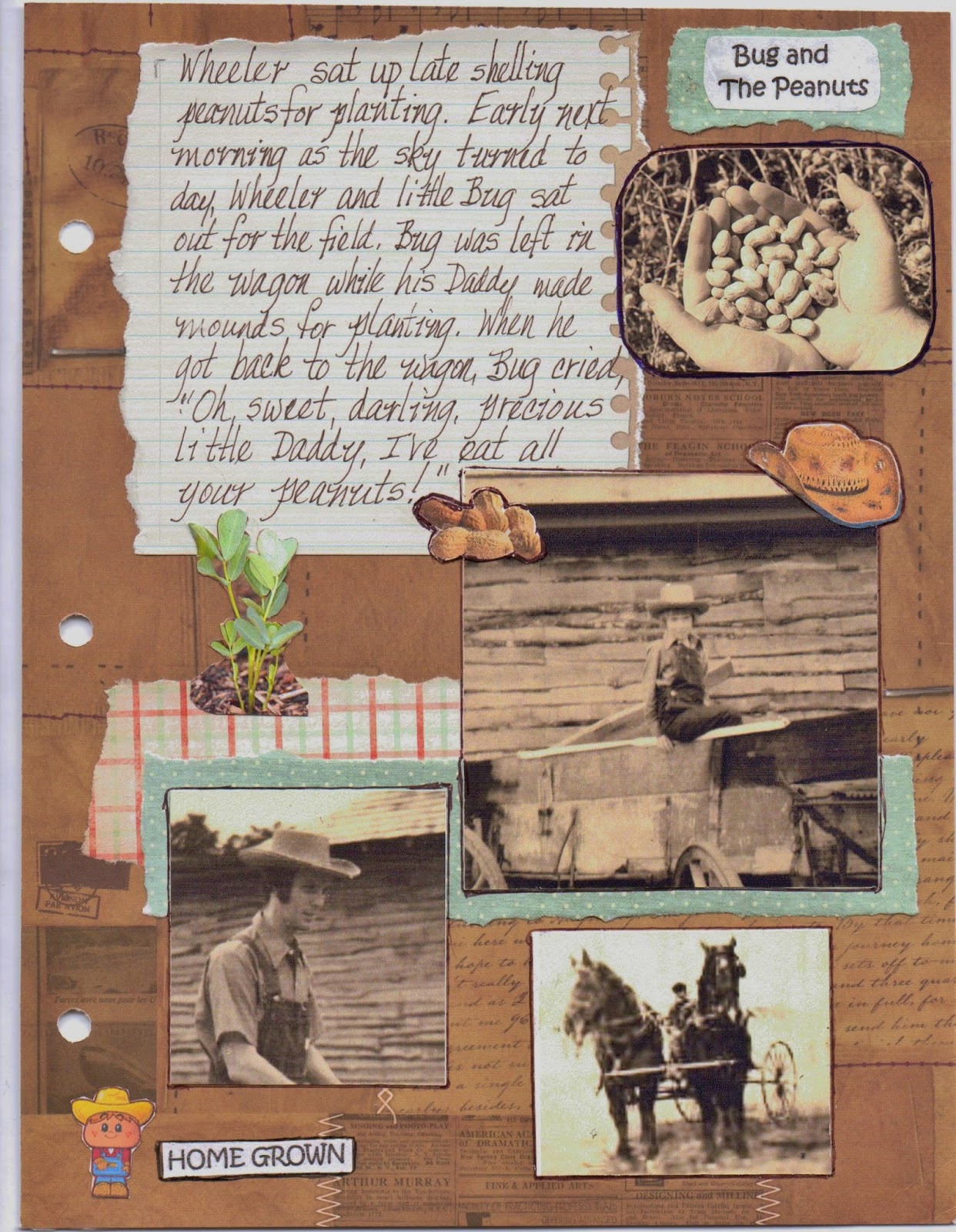
FYV Lesson 6: Bug and the Peanuts


Bug and the Peanuts

Peanut planting time!  It was late April, the weather was warm and Wheeler  knew if he wanted a harvest in early September, he needed to get the peanuts in the ground.  He had plowed the field the week before, walking behind ol’ Ham, his red, long-eared mule. 

Quite a few neighboring farmers had taken to planting  the peanuts in the shell instead of shelling them, but Wheeler was apt to do things the way he knew brought success. He shelled his peanuts. So, the night before planting, he was up late shelling his peanuts, careful not to remove the thin red skin that fostered germination.

Little Bug had just turned five and he wanted to be a farmer just like his Daddy. He could already milk ol’ Bonnie, the brown Jersey cow, and he could fill the manger with hay. He had helped plant the truck garden  this year and the early peas had already sprouted. And tomorrow he was going to help plant the peanuts. He was very excited – he was going to be a farmer!

Early next morning, Wheeler hooked ol’ Ham and Ben to the wagon and loaded up the basket of peanuts and a sleepy Little Bug.  It was a beautiful morning, the sun peaking over the mountains in a glow of pink and orange, gradually turning the dark sky to day. Bug ate a peanut, casting a guilty glance at his Daddy. He hadn’t noticed.

As they neared the field, Wheeler told the boy that he needed to turn over the soil and get the mounds ready for the peanuts. Bug was to wait in the wagon,  then he could come help plant.

Bug waited. He watched the sun come up, then turned his attention to the mules’ ears, watching them twitch, and he ate a peanut.  He examined an ant struggling with a bit of something bigger than he was, and he ate another peanut.  Time dragged by slowly and he ate another peanut.

Meanwhile, Wheeler was breaking up the sandy soil, making sure it was just right for planting.  He raked the soil into mounds where the peanuts would go.  He would show Bug how to push the nuts into the soil and cover them up.  An afternoon rain shower would be welcome and would provide the water for them to get a good start. He dusted off his hands and headed back to the wagon.

What was this?  Bug had been crying?  “What’s the matter, Son?” he asked.

“Oh, my sweet, precious, darling, little Daddy, I’ve done eat all your peanuts!”

And he nearly had!

 If you encounter a problem leaving a comment, (quite a few people have) please email me:
dyeconley@gmail.com.  Thanks!

Friday, July 26, 2013

FYV Lesson 5: Photo Stories

Prompt 3 - Storytelling Photos

Here is a short story in photos  
             
                              The Deer Come


The scout approaches cautiously. She sees me through the glass door but does not leave. Ever vigilant, she moves toward the food. All is well.  She trusts.


She allows the young deer to come.


Another, then another warily come forward to feed.


And these - well, I think they each tell a story all their own.  Let me know what you think...


 If you encounter a problem leaving a comment, (quite a few people have) please email me:
dyeconley@gmail.com.  Thanks!


FYV Lesson 5: When The Time Comes

When The Time Comes

The shaft of sunlight inched across the bed until it stabbed his eyes. He turned his head, not wanting to get up. He hurt. His muscles ached, his joints screamed with pain when he moved, his head felt too heavy to lift.  Then he remembered - today was the day...the time had come.

Slowly he ambled into the kitchen. “Good morning, Sunshine!” She smiled at him. “Got your breakfast ready.”  She put his breakfast down and kissed the top of his head. She sat down to eat, chatting about this and that, about the day ahead. He gazed at her, remembering the day they met, the years between then and now. He loved her. He loved everything about her – the way her hair curled up on the end, the bit of gray, the way her  eyes sparkled when she looked at him, the sound of her voice. He would miss her.

Too soon she was ready to leave. He walked her to the car. She turned and put her arm around him, “I have to stop at the grocery store after work, but I’ll be home in plenty of time for supper. You stay out of trouble.” She smiled. His heart ached.

He watched the car until it was out of sight. It was a beautiful day. The sky was such a bright blue and the clouds were so white and fluffy. He walked to the front yard. Past the bird bath where a vivid scarlet cardinal splashed. Past the rose bed and her red and pink and yellow roses. He remembered the day they planted them; well, the day she planted them. He had tried to help, especially with the digging, but she shooed him away and said she could do it by herself.

His gaze drifted across the road to the large empty field. One summer there was a tent revival there and they walked across the road to listen to the singing. What is it like to die, he wondered? Will I go to heaven like that preacher said? He didn’t know about those things; he wished he did.

In the back yard he thought about all the times they cooked supper on the deck. That was nice; especially afterwards when they just sat and enjoyed the summer night sounds. They had had a good life together, him and her. He hoped she would not be too upset with him.

He walked slowly up the path that led into the woods. That was one of their favorite things, walking through the forest together.  Shadows closed round him as he entered the cool darkness of the trees. Sounds of the birds and squirrels followed him down the familiar path. When he came to a fork, he turned and went away from their usual path.

He had found the place last fall. If you didn't know it was there, you wouldn’t find it, especially now that bushes covered it. He didn't want her to find him. He had to do this his way; it was better this way. There it was just ahead, just a small crevice between two boulders. He slipped inside.

Inside the small cave, it was dim, just a small bit of sunlight filtered through. At least here he would be dry if it rained, and it was cool.  Leaves had blown through the opening and covered the floor. He pushed them together to make a bed. There.

What is it like to die? Will there just be nothing or will I go to heaven? He was so tired. His legs throbbed from the walk, his muscles ached. He laid down on the bed of leaves, thankful for their comfort. When the time came - there was nothing left  now but to wait. He would think of her – remembering their time together - and wait. With a sigh, he laid his weary head down on his paws.


 If you encounter a problem leaving a comment, (quite a few people have) please email me:
dyeconley@gmail.com.  Thanks!